SmartBill - connect the service
This article explains how to connect your SmartBill account to xConnector and configure the main settings for invoicing, VAT, warehouse management, and product display on invoices.
The SmartBill configuration is divided into 4 sections:
- Account settings
- Invoice options
- VAT settings
- Warehouse
How to connect SmartBill in xConnector
xConnector -> Profile -> Connected services -> Connect a new service -> Invoices -> Connect an invoice service -> SmartBill
Before connecting SmartBill
Make sure you have the following details from your SmartBill account:
- SmartBill username
- SmartBill password
- SmartBill API Token
- company VAT code / tax code
- invoice series configured in SmartBill
- SmartBill warehouse, if you use warehouse stock deduction or stock synchronization
- SmartBill VAT rates, if you use special VAT configurations
The API Token can be found in SmartBill here:
SmartBill -> My Account -> Integrations -> API
1. Account settings
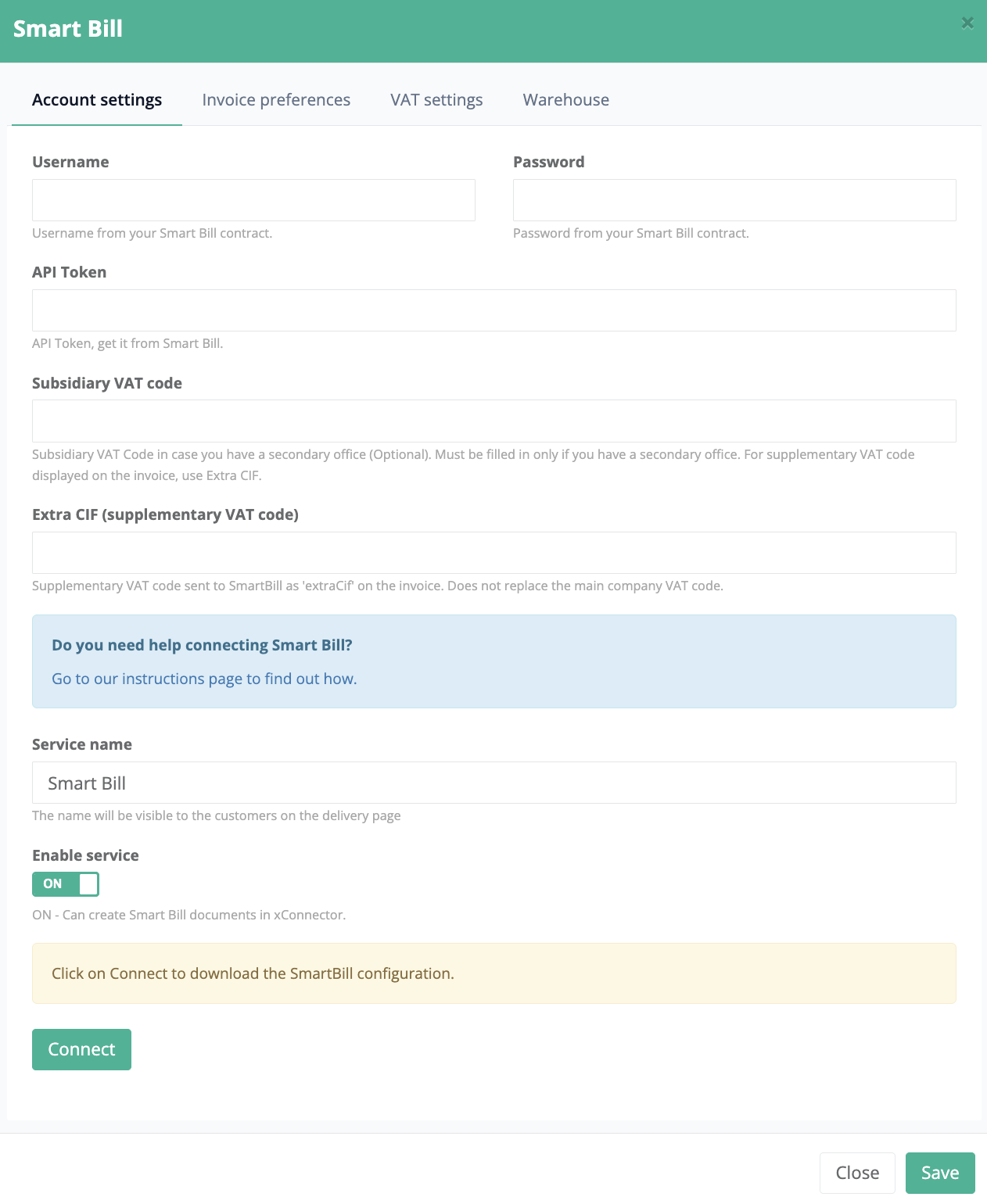
This section contains the connection details for your SmartBill account.
Username: Enter the username from your SmartBill account.
Password: Enter the password for your SmartBill account.
API Token: Enter the API Token provided by SmartBill.
The API Token must be copied exactly from your SmartBill account, without additional spaces before or after the value.
Subsidiary VAT code: Complete this field only if you use a VAT code for a secondary office or subsidiary. If you do not use a subsidiary VAT code, leave this field empty.
Extra CIF (supplementary VAT code): Complete in this field only if you need to send a supplementary VAT code to SmartBill. This value is sent to SmartBill as extraCif on the invoice and does not replace the main company VAT code.
Service name: Enter the name you want to use for identifying this SmartBill service in xConnector.
Service enabled: Select ON if you want to create SmartBill documents from xConnector.
If the service is disabled, xConnector will not generate invoices through this connector.
Connector type and Connector ID: These are technical fields used internally by xConnector. You do not need to change them.
Connect: After entering the connection details, click Connect to download the configuration from SmartBill.
This action allows xConnector to retrieve data such as:
- available companies
- invoice series
- VAT rates
- available warehouses
After you click on Connect:
If you receive the message Connection successful, the SmartBill connection was completed correctly.
If you receive the message Connection denied, check:
- SmartBill username
- SmartBill password
- API Token
- company VAT code / tax code
- whether the SmartBill user has API access
- whether any extra spaces were copied into the fields
After connecting succesfully, you can continue with the next configuration sections.
2. Invoice options
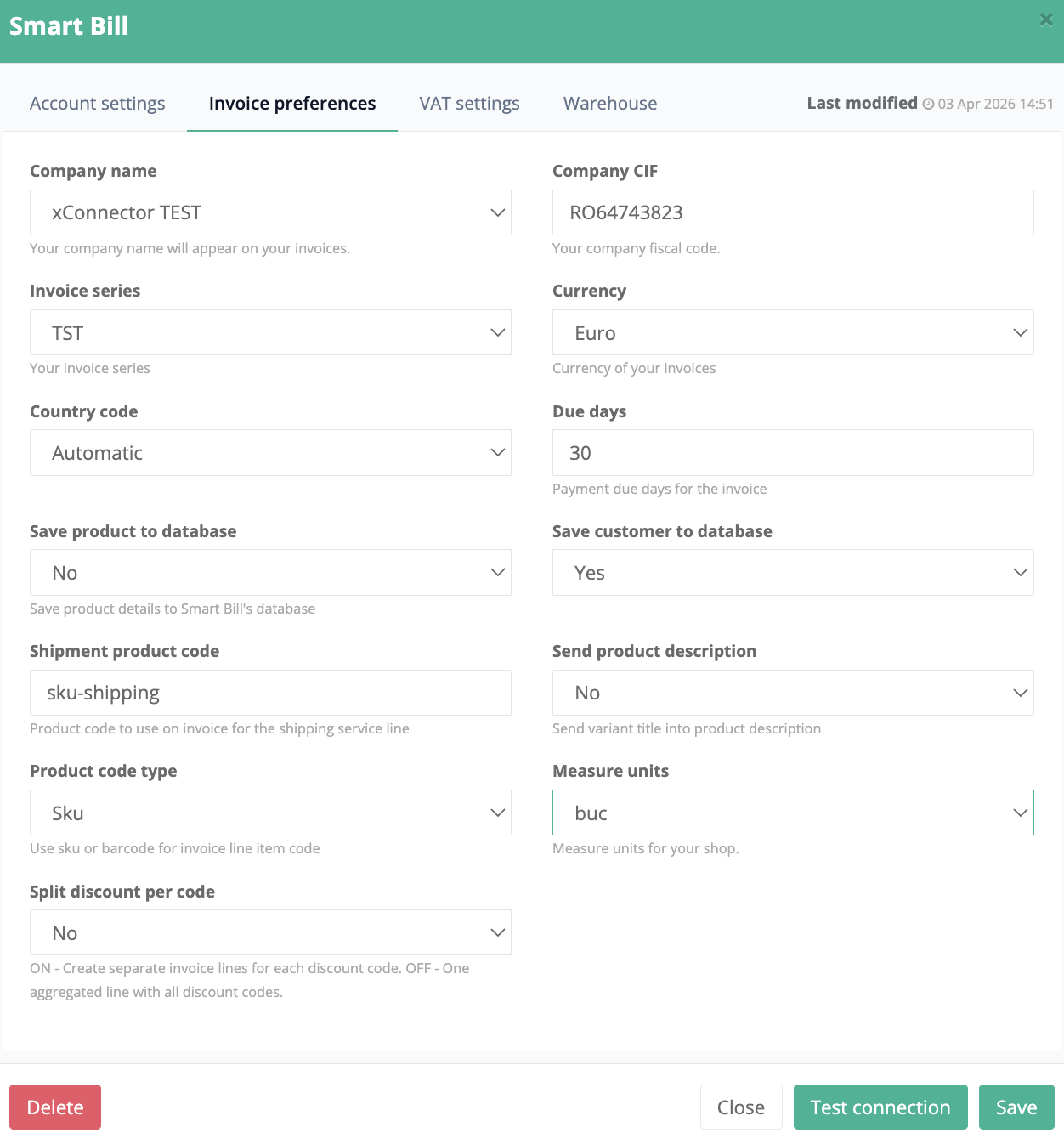
This section defines the information used when generating invoices.
Company name: Select the company for which the invoices will be generated.
The list of companies is retrieved from SmartBill after clicking Connect.
Company CIF: Select the company tax code. This must match the company selected in the Company name field.
Invoice series: Select the invoice series that will be used for documents generated from xConnector. The invoice series must already exist in your SmartBill account.
If the series does not appear in the list, go to SmartBill and add one, then return to xConnector and click Connect again (to retrieve the new modifications).
Currency: Select the currency used for invoice generation.
Country code: Choose how the country/language used for the invoice should be determined.The recommended option is Automatic, so xConnector can use the information available on the Shopify order.
Invoice due date: Enter the number of days until the invoice due date.
Save product to database:
Select Yes if you want products to be saved in the SmartBill product database.
Select No if you do not want products to be created automatically in SmartBill. If you use SmartBill stock management, the products should already exist in SmartBill, so this option is usually not required.
Save customer to database: If the customer already exists in the SmartBill database, the existing customer details will be overwritten with the information received from the Shopify order.
Select Yes if you want customer details to be saved in SmartBill. Recommend.
Select No if you do not want customers to be saved automatically in SmartBill.
Shipping service product code: Enter the product code used for the shipping service line on the invoice.
Examples: sku-shipping
This code will be used for the shipping/delivery line on the invoice.
Use product description: This setting controls whether the product variant is sent in the product description field.
Select Yes if you want the product variant to be sent separately in the description field.
Example:
Blue T-Shirt
Size XS
Select No if you do not want the product variant to be sent separately in the description field.
More details about product description here
Product code type: Select which code should be used to identify the product on the invoice:
- SKU
- Barcode
For correct functionality, the selected code must match the product code in SmartBill.
Example:
- if you select SKU, the Shopify SKU must be identical to the product code in SmartBill
- if you select Barcode, the Shopify barcode must be identical to the product code in SmartBill
Measure unit:
Select the unit of measure used for the products on the invoice.
Examples: pcs, buc, m etc
If warehouse management is enabled in xConnector, the unit of measure is automatically taken from the SmartBill warehouse/product database. This is recommended when your store sells products with different units of measure.
If warehouse management is not enabled in xConnector, the unit of measure selected in this field will be used for the invoice lines.
Separate discount by code
This setting controls how discounts are displayed on the invoice.
Select Yes if you want separate invoice lines for each discount code.
Select No if you want a single cumulative line for all discount codes.
3. VAT settings
Understanding VAT Configuration
VAT handling depends on your company's fiscal setup, the customer's country, the customer type and the order destination.
- Use HOME regime when invoices should follow the VAT rules of your company's country.
- Use OSS regime when invoices should follow the VAT rules of the customer's country.
VAT usage scenarios:
The examples below show how xConnector can send VAT information to SmartBill depending on the order type, customer country and fiscal setup.
Local sale in Romania
A Romanian company sells to a customer located in Romania.
In this case, the invoice normally uses the Romanian VAT rate configured for the shop. The company's national VAT code is used on the invoice.
Example: Romania -> Romania
VAT: Romanian VAT rate 21%
EU sale using OSS
A Romanian company sells to a private customer from another EU country and uses the OSS regime.
In this case, the VAT rate can be applied based on the customer's country. The intra-community / OSS VAT code can be sent to SmartBill and displayed on the invoice.
Example: Romania -> Germany
VAT: German VAT rate 19%
EU sale using home-country VAT
A Romanian company sells to a customer from another EU country, but the invoice must still use the Romanian VAT setup.
In this case, the invoice uses the Romanian VAT rate and the national VAT code of the company.
Example: Romania -> Germany
VAT: Romanian VAT rate
EU B2B sale with reverse charge
A Romanian company sells to a business customer from another EU country, and the customer provides a valid VAT ID.
In this case, the invoice can be generated with 0% VAT and the reverse charge VAT category. A reverse charge note can also be sent to SmartBill for the invoice.
Example: Romania -> France, business customer
VAT: 0% reverse charge
Export outside the European Union
A Romanian company sells to a customer outside the EU.
In this case, the invoice can be generated with 0% VAT using the export VAT category configured in SmartBill.
Example: Romania -> USA
VAT: 0% export
Set the VAT in Shopify
By default, Shopify calculates the VAT for each order, and xConnector forwards that information to SmartBill for invoice generation.
Therefore, make sure VAT is correctly configured in Shopify.
Useful configuration guides:
VAT Settings in xConnector
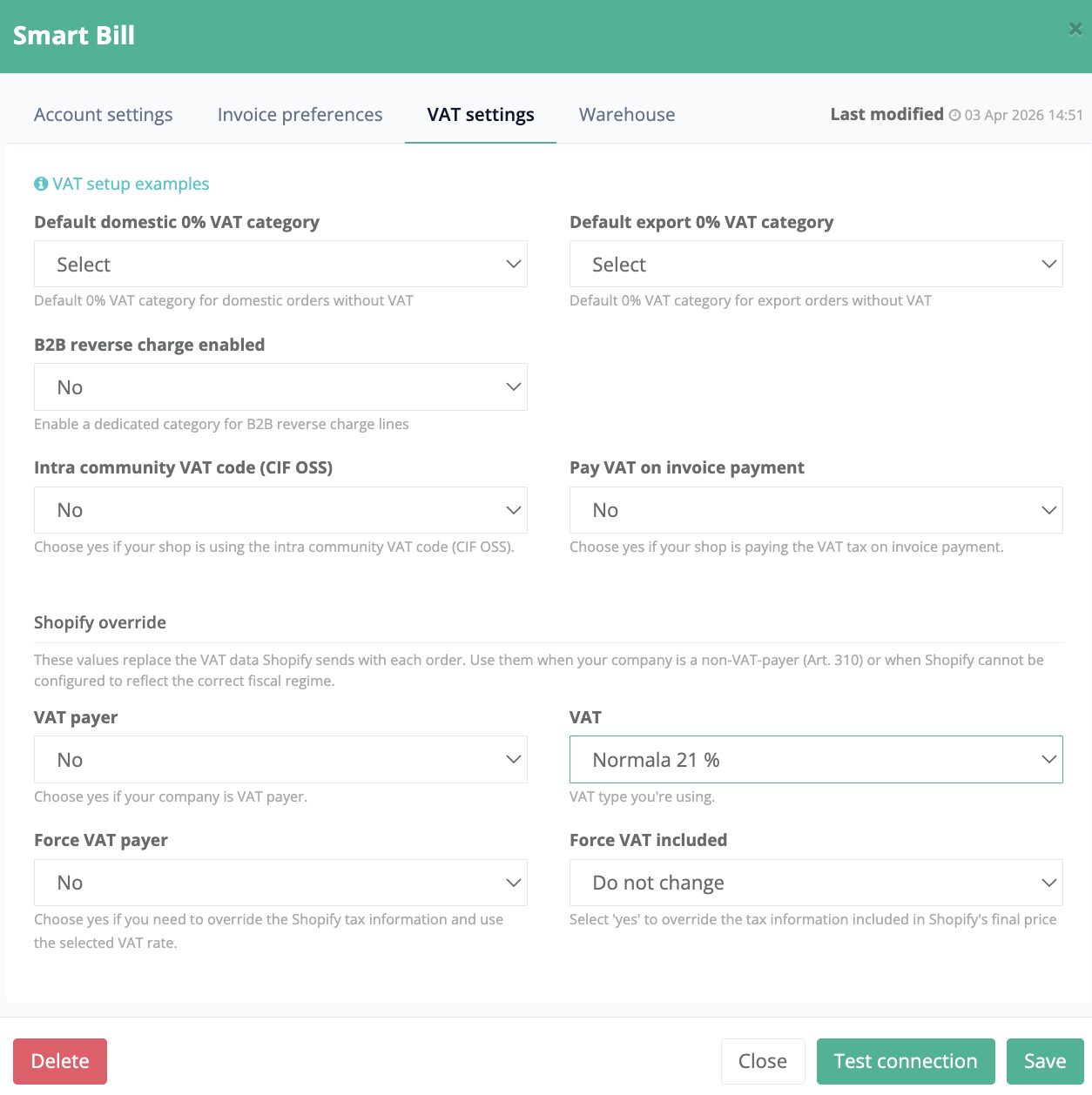
This section is used to configure how xConnector sends VAT information to SmartBill.
Default domestic 0% VAT category: Select the SmartBill VAT category that should be used for domestic orders without VAT.
This setting is useful when an internal order has 0% VAT, but SmartBill requires a specific 0% VAT category for the invoice.
Leave this field empty if you do not need a special 0% VAT category for domestic orders.
Default export 0% VAT category: Select the SmartBill VAT category that should be used for export orders without VAT.
This setting is useful for export orders where VAT is 0%, but SmartBill still needs to receive the correct VAT category on the invoice.
Leave this field empty if you do not need a special 0% VAT category for export orders.
B2B reverse charge enabled: Select Yes if you want to enable the dedicated VAT category for B2B reverse charge lines.
This setting is used for B2B orders where reverse charge applies.
Select No if your store does not use B2B reverse charge.
Intra community VAT code (CIF OSS):
Select Yes if your shop uses an intra-community VAT code / CIF OSS.
This option is used when your fiscal setup requires the intra-community VAT code to be sent to SmartBill.
Select No if this setup does not apply to your company.
Pay VAT on invoice payment:
Select Yes if your company uses VAT on payment.
This means that VAT becomes payable when the invoice is paid, according to your fiscal setup.
Select No if your company does not use VAT on payment.
Shopify override section
Use this section only when you need to replace the VAT information received from Shopify.
Normally, Shopify calculates the VAT for each order, and xConnector forwards this information to SmartBill when generating the invoice.
If some orders were created before VAT was correctly configured in Shopify, Shopify may send those orders with 0% VAT. In this case, you can use the options below to apply the selected VAT rate when generating the invoice in SmartBill.
Important: this override applies one VAT rate only. If your store uses different VAT rates for different products, you should configure VAT correctly in Shopify instead of using the override option.
VAT payer
Choose whether your company is a VAT payer.
- Yes - your company is a VAT payer
- No - your company is not a VAT payer
VAT
Select the VAT rate/category that should be used when overriding the information received from Shopify.
The list of VAT rates is retrieved automatically from SmartBill.
Force VAT payer
Select Yes if you want xConnector to override the tax information received from Shopify and use the selected VAT payer and VAT rate from this section.
Select No if xConnector should keep the VAT information received from Shopify.
Recommendation: enable this option only when you know exactly which VAT setup must be applied.
Force VAT included
This setting controls whether xConnector should override the information received from Shopify about VAT being included in the final price.
Possible options:
- Do not change - xConnector keeps the information received from Shopify
- Yes - xConnector forces VAT as included in the final price
- No - xConnector forces VAT as not included in the final price
4. Warehouse
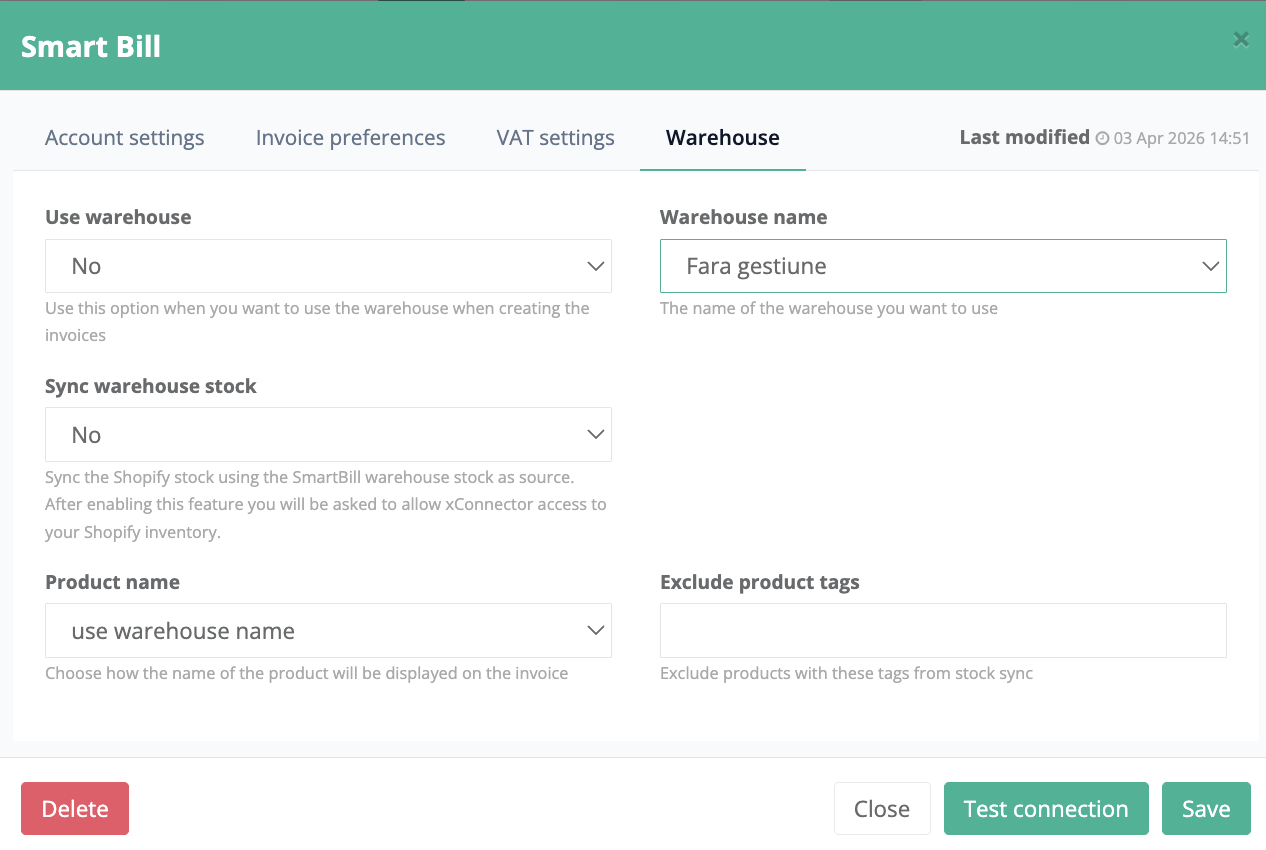
This section is important if you use SmartBill warehouse management, stock deduction, or stock synchronization between SmartBill and Shopify.
Use warehouse:
Select Yes if you want xConnector to update the SmartBill warehouse when you create or delete an invoice.
This option is used to deduct stock from SmartBill when an invoice is generated and you should also select the desired warehouse name.
Products must be identifiable between Shopify and SmartBill, usually by SKU or Barcode. Product matching can also work by exact product name, as long as the name is identical in both Shopify and SmartBill.
More details about stock discarge here.
Select No if you do not use SmartBill warehouse management.
Warehouse name
Select the SmartBill warehouse you want to use.
The list of warehouses is retrieved from SmartBill after clicking Connect.
If the warehouse does not appear in the list:
- check if the warehouse exists in SmartBill
- check if the SmartBill user has access to the warehouse
- click Connect again in xConnector to refresh the data
Sync warehouse stock
Select Yes if you want xConnector to synchronize Shopify stock using the stock available in the SmartBill warehouse. After activating this function, xConnector will request access to the Shopify inventory.
More details about stock sync here.
Select No if you do not want stock synchronization between SmartBill and Shopify.
Important: stock synchronization requires correct product codes. The SKU or Barcode in Shopify must match the product in SmartBill.
Product name
Choose how the product name should be displayed on the invoice.
Possible options:
- product name from Shopify
- product name from the SmartBill warehouse*
*This option is available only if warehouse management is enabled and a SmartBill warehouse is selected.
Exclude products by tags
Enter the Shopify tags for the products you want to exclude from stock synchronization.
This option is useful for products that should not be synchronized with the SmartBill warehouse.
Invoice automation settings
You can add extra information to the invoice from:
xConnector -> Profile -> Preferences -> Shipping and Invoicing
- How to configure VAT in Shopify
- How to configure multiple VAT rates in Shopify
- How to generate an invoice
- How to generate a domestic B2B invoice (Persoana juridica)
- How to send the invoice by email
- How to automatically mark payments in Shopify and in the invoicing platform
- How to cancel or reverse an invoice
- How to revert automaticaly an invoice for rejected parcel
- How to configure warehouse deduction and stock synchronization
- How to add the invoice link to the Order Status Page
- How to deduct stock for product sets
- How to deduct stock for product bundles
➡️ Need help with xConnector? We are just a message away:
Chat: click the blue chat icon (bottom-right)
E-mail: support@xconnector.app
Phone: +4 0373 747 991
➡️ Stay connected with xConnector:
Facebook group: https://www.facebook.com/groups/shopify.romania.xconnector
Facebook page: https://www.facebook.com/xConnectorApp
TikTok: https://www.tiktok.com/@xconnector.app
YouTube: https://www.youtube.com/@xconnector_app
Was this article helpful?
That’s Great!
Thank you for your feedback
Sorry! We couldn't be helpful
Thank you for your feedback
Feedback sent
We appreciate your effort and will try to fix the article